 By
By 

The Go Battle League is back in full ranked form. After the interlude that was Precious Paths, Season 26 — Memories in Motion — restored the familiar 24-rank ladder, brought weekly cup rotations into the spotlight, and added a fresh weekly bonus that gives competitive trainers more reasons to log in. Whether you are stepping into PvP for the first time or returning after a few seasons away, this guide walks through everything that matters: how the league works, what rewards are worth chasing, the current Great League meta, and the smart prep work that separates casual battlers from Legend-rank climbers. You can also skip ahead to our built-in PvP stats rankings tool to compare level caps, CP ceilings, and stat totals for every Pokémon across Great, Ultra, and Master League.

The season runs from March 3, 2026 to June 2, 2026, which means there is still a real window to push ranks, complete the seasonal Timed Research, and build a team that can compete deep into the climb.
What the Go Battle League Is
The Go Battle League — GBL for short — is Pokémon GO's global ranked PvP system. Players assemble teams of three Pokémon and battle other trainers in real time, with matchmaking handled automatically based on rank and rating.
There are three core formats that rotate throughout each season:
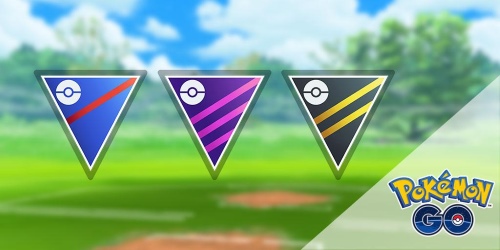
- Great League — 1,500 CP cap, the most accessible and resource-friendly format
- Ultra League — 2,500 CP cap, rewards investment in mid-tier Pokémon
- Master League — no CP cap, dominated by legendaries and maxed-out heavy hitters
On top of these, themed cups appear most weeks with type restrictions or other quirks. Memories in Motion features the Kanto Cup, Spring Cup, Jungle Cup, Electric Cup, Fantasy Cup, and a Catch Cup limited to Pokémon caught during the current season — a format that pushes trainers to actively build new teams rather than recycle old rosters.
To unlock the Go Battle League, a trainer must reach Level 10 and join a team (Mystic, Valor, or Instinct).
How the GBL Rank System Works
Currently, the Go Battle League is built on 24 ranks. Ranks 1 through 20 are numbered, followed by four titled ranks: Ace, Veteran, Expert, and Legend.
The system splits cleanly into two phases.
Phase one (Ranks 1–20) is participation-driven. Early ranks unlock just by completing battles, while later ones require winning a set number of matches. This phase is forgiving by design — you cannot drop a rank once earned. The bar to reach Rank 20 reverted this season, requiring 20 wins to advance from Rank 19. In theory, hitting Rank 20 takes about 107 wins minimum if every win lands exactly when needed. In practice, because excess wins from completed sets do not bank toward the next rank, most trainers end up needing somewhere between 157 and 238 wins to break through.
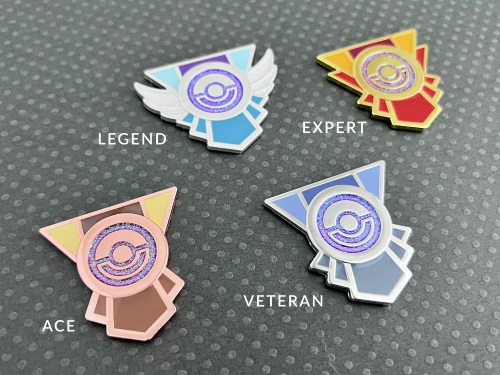
Phase two (Rank 20+) is rating-driven. Once you reach Rank 20, your performance is measured by a numerical ELO rating that rises with wins and falls with losses. The four titled ranks are gated by rating thresholds:
- Ace at 2,000+
- Veteran at 2,500+
- Expert at 3,000+
- Legend at 3,500+
A title cannot be lost once unlocked, but your rating can dip below the threshold — meaning a bad streak after hitting Ace will not demote you, but reaching the next rank gets harder if you tilt and lose ground.
Daily Battles and the Premium Battle Pass
The standard daily allowance is five sets of five battles, for a total of 25 matches per day. Each set begins with a choice between the Basic reward track (free) or the Premium reward track, which requires a Premium Battle Pass.
Memories in Motion introduces something new: GO Battle Thursday. Every Thursday for the entire season, the daily limit doubles to 10 sets — 50 battles total — and Stardust from win rewards is boosted up to 4×. This effectively replaces the old GO Battle Week format with a consistent weekly grind window.
The Premium Battle Pass doubles the Stardust payout per set and unlocks better encounter rewards at lower win counts. It is the same item used for Raid Battle entry, available from the in-game shop for PokéCoins or as a reward from select research tasks. For Stardust farmers and players chasing specific Pokémon encounters, premium is the obvious choice — especially on Thursdays.
Go Battle League Rewards Worth Chasing
GBL rewards arrive on two tracks: per-set rewards earned from individual wins, and milestone rewards earned as you climb the ranks.
Per-set rewards include Stardust, Rare Candy, Pokémon encounters, and randomized item drops that can include Fast TMs, Charged TMs, Sinnoh Stones, and Silver Pinap Berries.
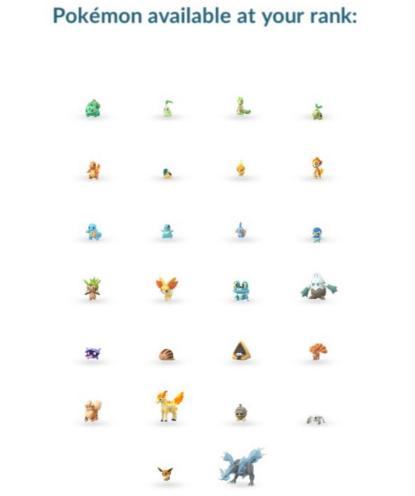
The Pokémon encounter pool is where things get interesting. The pool widens as you rank up, and Memories in Motion includes a mix of familiar staples and PvP-relevant picks: Totodile, Marill, Pineco, Duskull, Rookidee, Furret, Lileep, Lapras, Togetic, Beldum, Morpeko, Galarian Weezing, Galarian Corsola, Honedge, Jangmo-o, Frigibax, and Dreepy.
Rank 20 unlocks the most valuable encounter pool of all. After reaching Rank 20, the currently active 5-star Raid Boss can appear as a reward encounter — a way to grab legendaries without burning raid passes.
End-of-season rewards scale with your final rank. Reaching Rank 19 guarantees both an Elite Fast TM and an Elite Charged TM by season's end, while Ace and higher unlock the season's avatar items — for Memories in Motion, these are inspired by Blue from Pokémon: Let's Go, Pikachu! and Let's Go, Eevee!
The crown reward — exclusive to the very top — is Pikachu Libre, which only appears as an encounter for trainers reaching Legend.
Go Battle League Timed Research 2026
The seasonal Timed Research is one of the best free reward streams in the game, and Memories in Motion follows the format that's now standard.
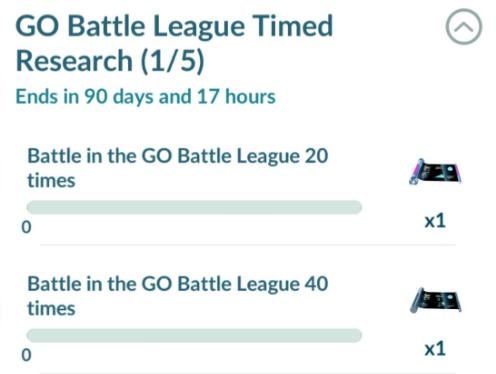
A free pass becomes available from the in-game shop once the season starts. Once redeemed, the research tracks your wins for the entire season, with no expiration as long as you grabbed the ticket in time.
The structure works like this:
-
Page one asks you to catch Pokémon and rewards encounters with species useful for team building — a deliberate on-ramp.
-
Each subsequent page requires 100 battles and 50 wins. Completing one awards Stardust along with items like Rare Candy XL, Elite Fast TMs, and Elite Charged TMs.
Stacking the Timed Research on top of normal rank rewards makes consistent daily play far more valuable than sporadic grinding. Elite TMs in particular are scarce resources used to teach legacy Community Day moves — they are worth the effort.
Building a Competitive Great League Team
The Great League is where most trainers spend the bulk of their time. The 1,500 CP cap means individual Pokémon strength matters less than typing, bulk, and energy efficiency.
Strong teams are built around three roles.
Lead is your opener — a Pokémon that wins or breaks even against a wide range of openers and pressures shields early. Safe Switch is the pivot you bring in when your lead is in trouble; it needs broad neutral coverage and enough bulk to survive being targeted on the swap. Closer finishes the game, ideally in a shieldless state with stacked energy or buffs.
The current Great League meta features several Pokémon that have remained competitive across multiple seasons:
Azumarill — Water/Fairy typing with very few weaknesses; Bubble builds energy fast, Play Rough and Ice Beam cover nearly everything
![azumarill battle]()
Medicham — Counter generates energy at one of the highest rates in the game, enabling repeated Power-Up Punch buffs that snowball into late-game sweeps
![medicham pvp]()
Galarian Stunfisk — Ground/Steel typing with 10 resistances and only three weaknesses; an outstanding safe switch
![galarian stunfisk]()
- Shadow Sableye and Galarian Corsola — top-tier safe switches with bulk and broad coverage
- Lapras — flexible bulk, best run with Psywave and Sparkling Aria for STAB plus coverage
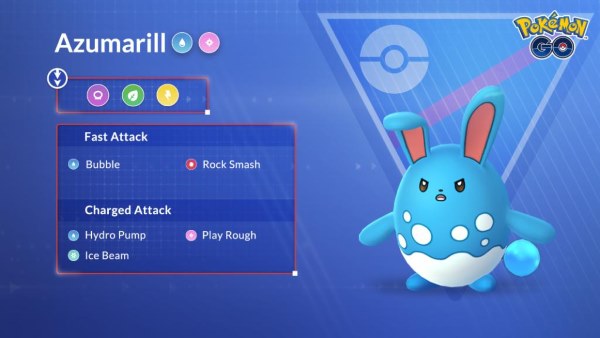
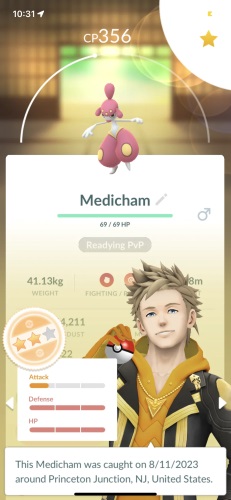
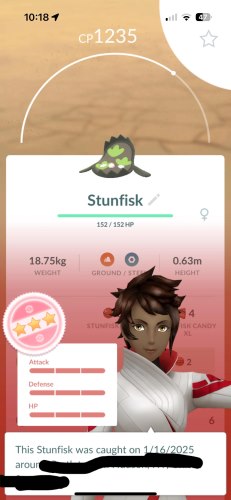
A reliable starter team for new battlers: Azumarill lead, Galarian Stunfisk safe switch, Medicham closer.
Memories in Motion also shifted the meta with several move changes worth knowing about. Gliscor learned Acrobatics, Moltres picked up Fly, Volcanion gained Scald, Pidgeot, Zapdos, and Togetic now have access to Heat Wave, Camerupt learned Scorching Sands, and Rotom received Leaf Storm. These additions reshuffle viability across the cup formats.
For IV optimization in Great League, lower Attack with higher Defense and HP generally produces better matchup outcomes — a counterintuitive but well-established principle. Tools like PvPoke can simulate matchups and team comps to help refine your picks. When you want to see how far a species can be powered before it hits the league CP cap — and which IV spreads squeeze the most out of that ceiling — use the PvP stats rankings tool in the next section.
PvP Stats Rankings: Level Caps and IV Playbooks
Every league format enforces a different CP ceiling, and that ceiling reshapes which Pokémon actually shine. A species with sky-high base Attack might never fit Great League at all, while a bulky mid-tier pick can dominate once you find the right level and IV spread. The rankings below answer a practical question: at the league cap, how high can this Pokémon go, and what do its Attack, Defense, and Stamina look like when it gets there?
Switch between Great League (1,500 CP), Ultra League (2,500 CP), and Master League to see how the same species changes. The algorithm selector lets you explore different goals — perfect IVs, maximizing Attack, maximizing Defense, or pushing level as high as possible — so you can compare how stat trade-offs shift before you invest Stardust and Candy.
Results default to the highest Attack totals, which highlights hard-hitting species at each cap. Sort by any column, search for a specific Pokémon, or expand the full list when you want to dig deeper.
Interactive PvP Stats Rankings
Browse level, CP, HP, IV spreads, and stat totals for 1,700+ Pokémon forms. Icons load lazily — only visible rows request images, so scrolling the full list stays lightweight.
| # | Pokémon | Level | CP | HP | IV (A/D/S) | Attack | Defense | Stamina |
|---|
The Hidden Grind: Why Walking Still Matters
Here is something most beginner GBL guides skip: winning battles is only part of the climb. The bigger investment is the prep work that happens outside of battle — and almost all of it is tied to walking.
XL Candy is the gatekeeper for top-tier teams. To power Pokémon past Level 40 (and up to Level 50 for max-level builds), you need XL Candy. It unlocks at Trainer Level 31 and is earned primarily through catching high-level wild spawns, walking with a buddy Pokémon (Level 31+ buddies have better drop odds), hatching eggs, and the rare Rare Candy XL drop from GBL wins. Powering a single Pokémon from Level 40 to 50 demands hundreds of XL Candy — a long-term commitment.
Eggs are an underrated source of both XL Candy and PvP-relevant species. Memories in Motion eggs include Beldum, Frigibax, Dreepy, and other species directly relevant to competitive team building. But eggs only hatch with kilometers — typically 2, 5, 7, 10, or 12 km depending on egg type.
Regional and event-specific Pokémon shape certain metas. Catch Cups restrict eligibility to Pokémon caught during the current season, which means any meta-relevant species spawning regionally or during weather-boosted windows becomes a chase priority. Some PvP picks like Uxie remain region-locked entirely.
PokéStop and Gym access funds the grind. Premium Battle Passes can be bought with PokéCoins earned from gyms. Stocking up on Stardust, items, and gifts requires consistent stop visits.
All of this assumes a trainer can walk freely, catch in varied biomes, and access enough gyms and stops to sustain the cycle. For players in rural areas, those with mobility limitations, busy professionals, or anyone whose neighborhood lacks density, this grind becomes the real bottleneck — not their battling skill.
Smarter GBL Prep With PoKeep Location Changer

This is where a tool like PoKeep Location Changer becomes genuinely useful for serious GBL trainers. PoKeep is a desktop GPS location changer for iPhone and Android that runs on Windows and macOS, requires no jailbreak or root, and is designed specifically for location-based games like Pokémon GO, Monster Hunter Now, and Soundmap.


The features that map directly to GBL prep work:
- Two-spot and multi-spot route modes simulate realistic movement between locations at customizable speeds — walking, cycling, or driving. This translates kilometers into egg progress and Buddy candy without requiring a physical walk, which is exactly the grind that feeds XL Candy supplies.
- 360° GPS joystick with W/A/S/D keyboard controls offers fine-grained movement for visiting nearby PokéStops, Gyms, and spawn points to stock items and grind PokéCoins for Premium Battle Passes.
- Jump teleport between multiple spots opens access to spawn pools in different biomes — useful for Catch Cup eligibility hunting and for catching season-relevant species that may not appear in your local area.
- Built-in cooldown timer calculates safe waiting periods between location changes. This is the responsibility feature: Pokémon GO enforces soft bans on accounts that jump unrealistic distances, and the timer keeps actions within natural movement boundaries.
The realistic-movement modes are particularly relevant for GBL trainers because they preserve the natural patterns that the game expects. Egg hatching, buddy walking, and standard PokéStop spinning all work on the same distance and timing logic regardless of how that movement is generated, as long as the movement looks natural to the game.
The Go Battle League itself is fundamentally a skill challenge: shield prediction, switch timing, and matchup knowledge cannot be automated. PoKeep simply ensures that the team you bring into battle is one your physical surroundings would not otherwise let you build.
Frequently Asked Questions
How many wins does it take to reach Rank 20?
The minimum is around 107 wins if every required win lands exactly when needed, but most trainers need 157 to 238 wins in practice because extra wins within a set do not bank toward future ranks.
How many GBL battles can I do per day?
The standard daily limit is 25 battles across five sets. On GO Battle Thursdays during Memories in Motion, the limit doubles to 50 battles across ten sets, with up to 4× Stardust from win rewards.
Is the Premium Battle Pass worth it for GBL?
For trainers actively grinding Stardust or hunting specific encounter rewards, yes. Premium doubles Stardust per set and shifts encounters to earlier win counts. Casual players can stick with the free track without missing rank progress.
What rank do I need for the 5-star Raid Boss encounter?
Rank 20. Once you reach Rank 20, the currently active legendary or Ultra Beast in 5-star raids can appear as a GBL reward encounter.
Which league should I focus on as a new player?
Great League. The 1,500 CP cap means competitive picks are far cheaper to build, and many top meta Pokémon are common species. Master League requires legendaries and maxed-out resources that take years to accumulate.
 Related Articles





 Leave Your Comment