 By
By 


You finally catch a high-IV Pokémon, spend Candy powering it up, and take it into battle—only to discover that its damage feels surprisingly weak. In many cases, the problem is not the Pokémon’s CP or IVs. It is the moveset.
Choosing the right Pokémon GO moves can completely change how a Pokémon performs. However, the best moveset for raids may be ineffective in PvP, an event-exclusive attack may be unavailable through a normal TM, and the move with the highest listed power may not produce the best real battle results.
This Pokémon GO moveset guide explains Fast Attacks, Charged Attacks, move statistics, TMs, legacy moves, PvE and PvP differences, Max Moves, and a repeatable method for choosing the best attacks for any Pokémon.
Complete Pokémon GO Moves Database
Use this interactive table to browse every Fast and Charged Attack in Pokémon GO. Fast moves show DPS, DPT, and EPT for raid and PvP comparisons. Charged moves show DPE so you can judge energy efficiency at a glance.
Move database
Browse every Pokémon GO Fast & Charged Attack
Switch between Fast and Charged attacks. Each view shows only the stats that matter for that move type.
Total moves
—
Fast attacks
—
Charged attacks
—
What Are Moves in Pokémon GO?
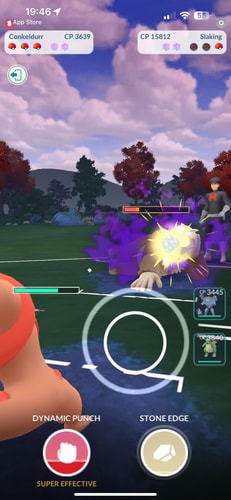
A Pokémon’s attacks are divided into two main categories: Fast Attacks and Charged Attacks.
Fast Attacks deal damage every time you tap the screen. They also generate the energy required to use Charged Attacks. Charged Attacks normally deal more damage, but they cannot be used until enough energy has been generated.
A Pokémon normally has:
- One Fast Attack
- One Charged Attack
- An optional second Charged Attack that can be unlocked with Candy and Stardust
The complete combination is called a moveset. In raids, a moveset usually refers to one Fast Attack and one Charged Attack. In PvP, a complete competitive moveset normally includes one Fast Attack and two Charged Attacks.
Fast Attacks vs. Charged Attacks
Fast Attacks
Fast Attacks determine how quickly a Pokémon can build energy. Some generate energy rapidly but cause limited direct damage, while others prioritize damage at the cost of slower energy generation.
A Fast Attack should therefore never be judged only by its displayed power. Its speed, energy generation, type, and interaction with the Pokémon’s Charged Attacks are equally important.
In Trainer Battles, Fast Attacks also have different durations measured in turns. This affects move counting, Charged Attack timing, and how much energy an opponent can gain before you act.
Charged Attacks
Charged Attacks consume the energy generated by Fast Attacks. They can serve several different purposes:
- Delivering heavy damage
- Forcing the opponent to use a Protect Shield
- Providing coverage against another type
- Raising or lowering battle stats
- Finishing an opponent before it reaches another attack
In Trainer Battles, energy can continue accumulating after the Charged Attack button becomes available. This allows a Pokémon to store energy and potentially use two Charged Attacks in quick succession.
Pokémon GO Move Stats Explained
Move databases display several statistics, but not every number matters equally in every battle format.
Power
Power is the base damage of an attack before factors such as typing, weather, Same-Type Attack Bonus, the attacker’s stats, and the opponent’s Defense are applied.
A move with higher power is not automatically better. It may require substantially more energy, take longer to execute, or be paired with a Fast Attack that generates energy too slowly.
Energy Generation
Fast Attacks generate energy. In raids, this is often represented as energy per second. In PvP, it is commonly measured as energy per turn.
Strong energy generation allows a Pokémon to reach its Charged Attacks more frequently. This can be more valuable than a small increase in Fast Attack damage.
Energy Cost
Charged Attacks require different amounts of energy. Lower-cost moves can be used frequently, while expensive moves generally take longer to reach.
A lower-cost attack is particularly valuable in PvP because it can:
- Pressure Protect Shields
- Threaten an opponent before it switches
- Allow the Pokémon to use stored energy before fainting
- Create uncertainty around a stronger second move
DPS
Damage per second, or DPS, is mainly used to evaluate attacks and movesets in raids and Gym battles.
DPS is useful, but it does not tell the entire story. A Pokémon with excellent theoretical DPS may faint quickly, lose stored energy, or force the player to spend more time relobbying.
DPT, EPT, and DPE
PvP analysis commonly uses three different metrics:
- DPT: damage per turn
- EPT: energy generated per turn
- DPE: damage delivered per unit of energy
These values help explain why some low-power attacks are competitively strong. A Fast Attack with high EPT can rapidly charge powerful moves, while a Charged Attack with strong DPE can deliver efficient damage.
How Type Effectiveness Changes Pokémon GO Moves
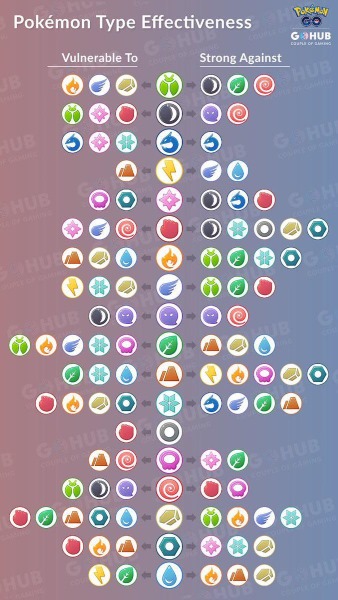
An attack deals more damage when its type is effective against the opponent. It can deal even more when the target’s two types share the same weakness.
A Pokémon also receives a damage boost when it uses an attack matching one of its own types. This is commonly called the Same-Type Attack Bonus, or STAB. Dual-type Pokémon can receive the bonus from attacks matching either of their types.
For example, a Fire-type Pokémon normally gets more value from a Fire-type attack than from an otherwise identical Normal-type attack. However, an off-type move can still be useful when it provides coverage against an opponent that resists the Pokémon’s primary attacks.
The practical rule is:
- Prioritize matching attack types and opponent weaknesses in raids.
- Consider both STAB and coverage in Trainer Battles.
- Do not assume every attack must match the Pokémon’s type.

Why the Best Pokémon GO Moveset Changes by Battle Format
There is no universal best moveset because raids, PvP, Team GO Rocket battles, and Gym defense reward different qualities.
Best Pokémon GO Moves for Raids and Gym Attacking
Raid battles are primarily damage races. The goal is to defeat the boss before the timer expires, so attackers usually need moves that exploit the boss’s weaknesses.
A strong raid moveset normally has:
- A Fast Attack matching the intended attacking type
- A Charged Attack of the same type
- Strong overall damage output
- Enough bulk to use its Charged Attacks before fainting
For example, a Pokémon capable of functioning as both a Dark-type and Rock-type attacker should not use a mixture of the two without a clear reason. A complete Dark moveset will usually perform better against a Psychic-type boss, while a complete Rock moveset will be more useful against a Flying-type boss.
Best Pokémon GO Movesets for PvP
PvP movesets need to account for Protect Shields, energy management, switching, stat effects, and team coverage.
A typical PvP moveset includes:
- An efficient Fast Attack
- A relatively accessible Charged Attack
- A stronger or differently typed second Charged Attack
The cheaper Charged Attack may be used to pressure shields, while the second attack threatens heavy damage or covers an unfavorable matchup.
Great League, Ultra League, and Master League can also favor different moves. A Pokémon facing Water-, Ground-, and Steel-type opponents in one league may need different coverage than the same Pokémon uses in another league.
Best Moves for Team GO Rocket Battles
Team GO Rocket opponents pause briefly after a Charged Attack or Pokémon switch. Because of this behavior, moves that generate energy quickly can be especially effective.
A practical Rocket moveset often prioritizes:
- Rapid Fast Attack energy generation
- Low-cost Charged Attacks
- Type advantage against the Rocket lineup
- Enough bulk to survive several opponents
A move that ranks below another option in raids may still be the better Rocket choice because it reaches Charged Attacks more frequently.
How to Change Moves in Pokémon GO
Pokémon GO provides regular TMs and Elite TMs for changing attacks.
How Regular Fast and Charged TMs Work
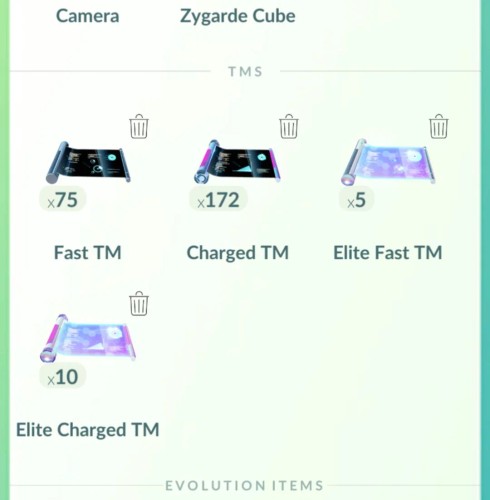
A Fast TM replaces the Pokémon’s current Fast Attack with another eligible Fast Attack. A Charged TM does the same for a Charged Attack.
Regular TMs select the new attack randomly from the Pokémon’s currently available move pool. They do not normally let you choose the result and cannot teach event-exclusive moves.
If a Pokémon has only two eligible Fast Attacks, one Fast TM normally switches it to the other option. If it has a large Charged Attack pool, several Charged TMs may be required.
Should You Use TMs Before or After Evolution?
Use TMs after reaching the final evolution you plan to battle with.
Evolution gives the evolved Pokémon attacks from its own move pool. A Fast or Charged Attack selected for the lower evolution is not guaranteed to remain after evolution.
Powering up before or after evolution generally does not change the final power-up cost, but using TMs before evolution may waste those items.
What Are Elite TMs?
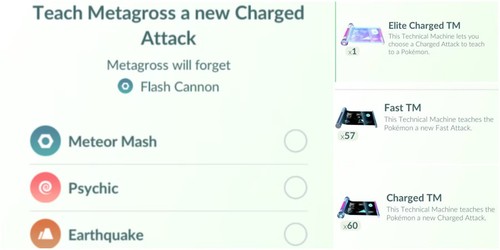
Elite Fast TMs and Elite Charged TMs allow you to choose an eligible attack instead of receiving a random result. They can also teach certain attacks that were previously available only during Community Days, Raid Days, or other events.
When a Pokémon knows two Charged Attacks, using an Elite Charged TM lets you choose which slot to replace.
When Is an Elite TM Worth Using?
An Elite TM is most valuable when:
- The exclusive move significantly improves the Pokémon
- The Pokémon is already suitable for long-term use
- The move is important for its intended raid or PvP role
- No announced event will provide the attack soon
- The Pokémon cannot obtain the attack through a regular TM
Do not use an Elite TM simply because a move is rare. Some exclusive moves are essential, while others are sidegrades or collection options.
What Are Legacy and Event-Exclusive Moves?
A legacy move generally refers to an attack that is no longer part of a Pokémon’s regular move pool. Event-exclusive moves are available only under particular conditions or during specific periods.
A featured attack may be obtained by:
- Evolving during a Community Day window
- Catching a Pokémon from an event encounter
- Defeating and catching it from a raid
- Completing research
- Using a regular TM during an announced exception
- Using an Elite TM after the move becomes eligible
Community Day featured Pokémon commonly learn their exclusive attack when evolved during the event or within the stated post-event window. These attacks may later be added to the Elite TM pool.
Do not assume that catching the base Pokémon during an event guarantees the move. Some attacks require evolution, while others are attached directly to catches or raid encounters.
Should You Unlock a Second Charged Attack?
A second Charged Attack is highly valuable in PvP because it provides coverage and creates uncertainty for the opponent.
It can also be useful for:
- Pokémon that perform two PvE roles
- Mega Pokémon used against different raid bosses
- Team GO Rocket counters
- Pokémon with one cheap move and one finishing move
However, the Candy and Stardust cost varies by Pokémon. Rare, Legendary, Mythical, and Shadow Pokémon can be particularly expensive.
Unlock a second Charged Attack when the second move has a clear purpose. For a raid attacker that only needs one type of damage, the investment may provide little immediate benefit.
Pokémon GO Shadow Moves: Frustration and Return
Shadow Pokémon deal additional damage with their Fast and Charged Attacks, but they also take additional damage from opposing attacks.
Newly caught Shadow Pokémon know Frustration. Under normal conditions, Frustration cannot be removed with a Charged TM. Special Team GO Rocket events occasionally allow players to remove it.
For example, the Flying Taxi: Taken Over event from June 25 to June 29, 2026, temporarily allowed Charged TMs to remove Frustration. That event has ended, so another officially announced window is required.
Purifying a Shadow Pokémon replaces Frustration with Return. Return can later be replaced with a normal Charged TM, but restoring Return afterward may not be possible.
Before purifying or removing a special attack, check whether the Pokémon benefits more from its Shadow damage bonus, Return, or a different Charged Attack.
How PoKeep Helps You Build Pokémon GO Movesets More Efficiently

PoKeep Location Changer does not modify Pokémon attacks or guarantee a specific move. Its practical value comes earlier in the process: helping players reach the Pokémon, raids, Power Spots, PokéStops, and event areas needed to collect moveset-building resources.


This can be especially helpful when the Pokémon you need is unavailable nearby or when local access to raids and resource-rich areas is limited.
PoKeep includes:
- One-click GPS location changes
- A 360-degree movement joystick
- Two-point and multi-point route simulation
- Jump teleport mode
- Adjustable simulated movement speed
- Favorite locations and route history
- GPX route importing
- A built-in cooldown timer
It supports iOS and Android devices without requiring an iPhone jailbreak or Android root.
Use PoKeep to Reach Moveset-Building Opportunities
A complete Pokémon GO moveset often requires more than a TM. You may also need Candy, Stardust, raid encounters, evolution opportunities, or Max Particles.
PoKeep can support activities such as:
- Moving to areas with more PokéStops to collect items.
- Exploring routes with more spawns for Candy farming.
- Reaching raids featuring the Pokémon you want to build.
- Visiting Power Spots to collect Max Particles.
- Saving productive farming locations for later use.
- Simulating a route instead of repeatedly selecting individual map points.
The multi-point movement mode is particularly useful for creating routes through clusters of PokéStops, Gyms, and spawn areas. Jump teleport mode is designed for checking multiple separated locations, while the cooldown timer helps track the waiting period after longer location changes.
What Are Max Moves in Pokémon GO?
Max Moves are separate from ordinary Fast and Charged Attacks. They are used by eligible Dynamax and Gigantamax Pokémon during Max Battles.
There are three main Max Move functions:
- Max Attack: deals damage and is generally based on the Dynamax Pokémon’s Fast Attack type
- Max Guard: creates a barrier that reduces incoming damage
- Max Spirit: restores HP for the user and allied Pokémon
Changing a Dynamax Pokémon’s Fast Attack can therefore change the type of its damaging Max Attack. Gigantamax Pokémon may instead use a unique G-Max Move.
How to Unlock and Level Up a Max Move
Max Particles and Pokémon Candy are used to unlock or train Max Moves.
To train one:
- Open Pokémon Storage.
- Select an eligible Max Pokémon.
- Scroll to its Max Moves.
- Choose the move you want to train.
- Select the available level.
- Confirm the required Max Particles and Candy.
Max Moves can only be used in applicable Max Battles. A Dynamax Pokémon can still enter ordinary raids, Gyms, and Trainer Battles, but it cannot Dynamax or use Max Moves in those formats.
Because unlocking and upgrading Max Moves involves a separate resource system, detailed Max Move costs are better handled in a dedicated guide.
Pokémon GO Moves FAQ
What is the best move in Pokémon GO?
There is no single best move. The answer depends on the Pokémon, opponent, battle format, typing, energy generation, move cost, and team composition.
What is the difference between a move and a moveset?
A move is one individual attack. A moveset is the combination of Fast and Charged Attacks assigned to a Pokémon.
Can a Pokémon have two Charged Attacks?
Yes. A second Charged Attack can be unlocked with Candy and Stardust. The cost depends on the Pokémon.
Can regular TMs teach legacy moves?
Normally, no. Regular TMs randomly select from the Pokémon’s current regular move pool. Eligible legacy and event-exclusive attacks usually require an Elite TM or a specific event.
Are Elite TM moves always better?
No. Some exclusive moves are major upgrades, while others are situational or unnecessary for the Pokémon’s intended role.
Do Pokémon moves change after evolution?
Yes. Evolution assigns attacks from the evolved form’s move pool, so the lower evolution’s current moves are not guaranteed to remain.
Should raid and PvP Pokémon use different moves?
Often, yes. Raid moves prioritize type-focused damage and battle speed, while PvP movesets must consider energy, shields, coverage, effects, and matchups.
Does a higher-power Charged Attack always deal more useful damage?
No. A lower-power attack may have a lower energy cost, better type coverage, useful stat effects, or greater consistency.
Can Max Moves be used in Trainer Battles?
No. Max Moves are limited to applicable Max Battles.
Final Tips for Choosing Pokémon GO Moves
The best Pokémon GO moveset is not simply the combination with the highest displayed power. It is the combination that fits the Pokémon’s role, reaches Charged Attacks efficiently, covers the right opponents, and can actually be obtained with the resources available.
Once the target moveset is clear, PoKeep can help streamline the exploration and resource-gathering stage by providing access to virtual movement, saved routes, raid areas, Power Spots, and PokéStop clusters. The move itself still comes from Pokémon GO’s normal battle, TM, evolution, and event systems.
 Related Articles







 Leave Your Comment